sponsored links

Audi A8 facelift


Audi A8 facelift

How much? £49,995
On sale in the UK: Now
Engine: 2773cc, 24V, V6, 207bhp, 207lb ft
Transmission: Multitronic continuously variable transmission, with seven selectable speeds
Performance: 0-62mph 8.0secs, 147mph, 34.0mpg, 199g/km
How heavy / made of? 1690kg/aluminium
How big (length/width/height in mm)? 5062/1894/1444


I'm sorry, did you say this was a mid-life facelift for Audi's luxury A8?

Fair enough – the cosmetic changes aren't that exciting. In fact, they're really rather difficult to spot, being limited to some new front grille colours, re-arranged LEDs in the tail-lights, and new LED indicator strips in the door mirrors. Plus a different alloy wheel or two (or four for the sake of cosmetics). But under the skin, Audi's been busier tweaking the mechanicals to make an already refined car even quieter. It's also rustled up some extra equipment, added some toys to the options list, and – stop the press – boosted the engine range by dropping in a new 2.8-litre V6 petrol engine.


A new 2.8-litre petrol? Be still my beating heart...

OK, so it isn't all that stimulating, though 0-62mph in 8.0 seconds and 147mph isn't really hanging about – on paper, at least. But that's not the point. While we wouldn’t usually be that bothered about a new entry-level powerplant, producing only 199g/km of CO2 makes it by far the most environmentally friendly combination of car and engine in the luxury saloon class. All achieved via clever FSI direct injection, Audi's efficient new valvelift technology, and a Multitronic CVT auto. Average economy of 34.0mpg is impressive for a luxo-barge, too.


That sounds good. What's the catch?

This new 2.8 is two-wheel drive only and is stacked to the roof with safety acronyms to make up for the loss of Audi's quattro four-wheel-drive system. Even without the 4wd heft, it does seem to lack a bit of get up and go. Put your foot down on the motorway and the engine spools up into an angry thrash but you don't get any of the boardroom dictator-grade thump you'd expect in a car of this size. Its 207bhp sounds adequate, the problem is that with only 207lb ft of torque it just doesn't generate enough low-down thrust – especially when the 3.0-litre TDI diesel costs only £1000 more, and generates a far more respectable 332lb ft of pull.


Er, so what's the point of this new 2.8 petrol engine, then?

We're not altogether sure. Even though the difference in company car tax – 27 percent for the 2.8, 35 percent for the 3.0 TDI – shouldn't be ignored for business users, both engines come in at under 225g/km of CO2, which will be important if proposed changes to the London Congestion Charge go ahead. No-one at Audi is prepared to even guess how many of the £49,995 2.8 FSIs will find homes; currently about three-quarters of all A8 buyers leave the dealer with a diesel engine. Still, every little helps – and if people are prepared to splash out for the fuel devouring S8 and W12 models, there's got to be room for such economical luxury.


Ah, the other engines – I'd almost forgotten. How are they getting along?

Just fine it seems – there are no other major changes to the A8's oily bits. But Audi has revised the suspension and steering settings in this facelift. This has taken nothing away from the existing car, but the changes are hardly revolutionary, either – the steering’s slightly more linear, the ride supposedly smoother (but still fidgety – especially if you opt for the sport package). However, Audi claims improvements to refinement make the A8 the quietest car in class – and our autobahn experiments confirm it as a very hushed place to sit. You can't quite hear a pin drop, but normal conversation is easy deep into three-figure speeds.


Good stuff. What about the new toys you mentioned?

The A8 has always been comprehensively equipped as standard – what with range-wide adaptive air suspension, sat-nav, leather and iDrive-shaming Multi Media Interface (MMI). But you now also get four-zone climate control for your money, and a nifty DAB digital radio. New to the options list are blindspot monitors (blinking LEDs if you're in danger of pulling out into someone), lane assist (jiggling steering wheel if you stray over a motorway line without indicating), and a ceramic brake package for the hot S8 and W12 versions. There's also a Sport trim line with bodykit and two-tone leather. And don't forget the £4500 Bang & Olufsen stereo – after all even a Mazda 3 has a Bose system these days.


Verdict

As you were. The revised A8 builds on an already impressive package without ever being in danger of adding that killer hook. If you've already got your sights set on a 7-series, S-class, LS or XJ, don't worry about missing out. But the A8 is still an excellent car, and its gradually strengthening market position (2006 was the A8’s best ever year) seems set to continue – even if the new 2.8 FSI petrol is a tiny bit pointless unless low company car tax is paramount.

CAR's rating

rating is 3

Handling

rating is 3

Performance

rating is 3

Usability

rating is 4

Feelgood factor

rating is 3

Readers' rating

rating is 3.5

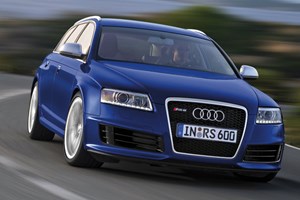
Audi RS6 Avant


Audi RS6 Avant

How much? £77,625
On sale in the UK: Now
Engine: 4991cc, V10, 40v twin-turbo, 572bhp @ 6250rpm, 479lb ft @ 1500-6250rpm
Transmission: Six-speed semi-automatic transmission, four-wheel drive
Performance: 4.6sec 0-62mph, 155mph (limited), 20.1mpg, 333g/km CO2
How heavy / made of? 2025kg/steel
How big (length/width/height in mm)? 4928/1889/1460


Another performance car for the mid-life crisis, then?

Harsh. The Audi RS6 carries on what the original car started back in 2002: it’s an all-wheel drive large family car – the estate goes on sale first to stress its versatility – with supercar-crushing performance. And that’s no hyperbole. With its 5.0-litre V10 – a heavily re-worked version of the 5.2-litre naturally aspirated unit we’ve already seen in the 429bhp S6 – aided and abetted by not one but two turbos, the RS6 musters 572bhp at 6250rpm and a torque curve that’s anything but curvy – the maximum 479lb ft is available from just 1500rpm all the way to 6250rpm.

Forget the obvious BMW M5 Touring and Mercedes E63 AMG comparisons, this is Lamborghini territory.


Aren’t the M5 and E63 comparisons kind of essential?

Both these rivals are rear-drive only with naturally aspirated powerplants (M5: 5.0-litre V10; E63 6.2-litre V8) that lose out to the RS6 with 500bhp and 384lb ft and 507bhp and 464lb ft respectively. On paper – and on a damp and twisty road – the RS6 has the upper hand. The trade-off comes in the shape of a £77k purchase price – £10k more than the M5 and £8k more than the Merc.


How does it drive?

Impressively. It pulls off the around town stuff admirably. There’s light steering, good visibility – the rear-facing camera helps guide you into those tricky parking spaces – a smooth ride and some very comfy seats. Only the edgy, ultra-aggressive throttle gives the game away.

Hit the open road, open the throttle only a quarter of the way and the RS6 gathers momentum at an astonishing pace. Bury the pedal deep into the carpet and there’s a bassy eruption from under the bonnet, a cacophonous thunderclap between gearshifts and a sense that – even though you’re now moving at highly illegal speeds – everything’s in hand.


A twin-turbo V10 that goes quite quickly? Well I never…

Okay, the revealing stuff. The quattro system splits torque 40/60 front-to-rear. Thread through a fast but twisting road and you do get that satisfying sense of rear bias. But take to the hairpins and it’s the nose that pushes wide, making for jerky progress as the master of four-wheel drive tries to calm your exuberance. Here the M5 in particular would be sharper, gripping hard at the front while the rear powers on.

While the steering is light at low speeds, it is speed-sensitive. And although that lends an artificial edge, it does offer a very real and consistent heft right from the moment you turn in. Not wishing to be sexist, but working against this resistance is the most obvious sign that you’re in a Man’s Car. If you’re thinking about dual duties behind the wheel, let the other half have a test drive too.


And you say it’s got a smooth ride? In a sporty Audi?

Believe it. There are three suspension settings to choose from: Comfort, Dynamic and Sport. Body control gets a little too sloppy for our liking in Comfort (though it’s nice to have the option for straddling urban potholes), Dynamic offers the everyday compromise while Sport really tightens up the damper control which makes for the sort of short, spiky vertical movements that are best avoided after feeding a young family. Yet the ride still isn’t crashy.

However, all three controls are only accessible via the multi-media interface so you press ‘car’, then select ‘suspension’, then choose your setting. It’s easy enough to locate and avoids more buttons cluttering up the dash, but it’s not as intuitive as pressing a ‘sport’ button when you stumble across that dream bit of tarmac.


I’ll take the manual, please.

Only a six-speed tiptronic gearbox is offered but it’s actually very good, responding to your paddleshift inputs in a tenth of a second and making a good job of second-guessing what you want in full automatic mode. It’ll even let you crash into the limiter with a noisy rat-a-tat-tat. We’re all for having that degree of control over a semi-auto, but it can catch you out initially. That’s because the car charges to the rev limit so quickly and because the flat torque delivery mutes the kind of soaring crescendo you might expect from such a powerful car. Not a complaint, just an observation.

So let’s make a complaint: why do the paddles have to move with the steering wheel? You never know where they’ve gone when you get into the really twisty stuff and once you’ve got accustomed to using them it’s difficult to suddenly recalibrate and bang the gearstick down the ’box. Fixed paddles please.


How does the RS6 get on at the track?

The track is not the natural environment for a two-tonne estate car with four-wheel drive. And as much as we love lapping the Paul Ricard test track, the RS6 was not the car we’d have chosen. There’s absolutely no fun to be had in finding this car’s limits. Get some satisfying oversteer and it’ll only be overruled by clumsy understeer. So you end up winding back a little and driving within the grip limits. So you never feel like you’re really pushing and, strangely, a 5.0-litre twin-turbo V10 manages to feel ever so slightly pedestrian.


However, the track did allow us to try out a couple of options: bucket seats and ceramic brakes. The buckets are much more aggressive than the standard chairs (only 10 percent of buyers are expected to spec them) and are manually adjusted save for the trick bolsters which tighten around you at the press of a button. Good as the buckets are, we’d stick with the standard chairs unless you’re spending much time on track – and, as we’ve said, that’s not a place we’d be heading with the RS6.

We’re even less certain about the ceramic brakes as we only got three laps of the circuit and had to come in to cool down at the end of each one. As ceramics usually work at their optimum with some heat in them, we struggled to notice any difference over the perfectly adequate standard stoppers.


Verdict

Does the world need an Audi RS6? Not really, but Audi predicts that around 8000 people will and that’s good enough for Ingolstadt. If you’re wealthy, love performance cars, have a family and take the odd excursion to winter climes, the RS6 will appeal. But you’ll struggle to tap into its limits on the road and it’s not much fun when you find them on the track.

As a driver’s tool, the M5 is more convincing, has the more engaging power delivery and a more exploitable chassis that still offers huge amounts of grip – if it’s wet just leave the traction control on! It’s also £10k cheaper.

Credit where it’s due, though. The RS6 is an accomplished machine: well-built, beautifully engineered, desirable and incredibly fast. If you can stomach a best of 20.3mpg on the combined cycle and couldn’t care less about heroic missions in search of the limit, you’d better put your order down quickly.

CAR's rating

rating is 4

Handling

rating is 4

Performance

rating is 5

Usability

rating is 5

Feelgood factor

rating is 5

Readers' rating

rating is 3

Audi A4 3.2 quattro


Audi A4 3.2 quattro

How much? £28,815
On sale in the UK: February 2008
Engine: 3197cc 24v V6, 261bhp @ 6500rpm, 243lb ft @ 3000rpm
Transmission: Six-speed manual, four-wheel drive
Performance: 6.2sec 0-62mph, 155mph, 31mpg, 219g/km CO2
How heavy / made of? 1580kg/steel
How big (length/width/height in mm)? 4703/1826/1427


This new Audi A4, it looks classier than before...

Audi has moved its game on, as indeed it had to. With squarer proportions than the ubiquitous 3-series, this forthcoming A4 looks decidedly more imposing on the road. There’s a considerably longer wheelbase – look at that BMW-esque front-wheel-in-the-front-corner stance. In turn, that pushes the engines further behind the front axle line to increase the balance. But it’s the R8-style daylight driving lights that really make the A4 stand out in an instant, even if you need to opt for the £775 xenon light pack to get them. Is Audi chasing the pushy BMW image? It makes us wonder...


Longer wheelbase? Isn’t a cramped interior a given in compact execs?


It’s increasingly less the case. But while each new iteration of any car inevitably involves an increase in size these days, the A4 gains an extra 54mm in the wheelbase, most of which appears to have gone into increasing rear legroom. That, according to Audi’s figures, makes it the roomiest of the three German contenders. The A4 is long, too, an eye-catching 200mm longer than the BMW and Mercedes. But while that puts the latest A4 on a par with earlier versions of the A6, it’s still a long way short of the layabout space you get in a new Mondeo.


Does the interior measure up in other respects?

Audi has moved its game even further away from rivals with a result that drivers moving down from an A6 or even an A8 won’t feel short-changed. It's that good. There is a lightness of touch here, a calculated use of aluminium, cloth and leather there. It really lifts the interior. The usual Audi tactile switchgear helps, too. The A4 gets the MMI control interface from the A6, which is arguably either slightly easier or slightly fiddlier to operate than BMW’s iDrive, as well as an electro-mechanical parking brake with hill start assist. There’s a deeply impressive optional B&O sound system too.


But mechanically, this is just another no-surprises VW Group package, right?

Far from it. The longer wheelbase changes the chassis balance, and in the 3.2 V6 the quattro drive now channels 60 percent of the torque available to the rear wheels. That V6 now has 262bhp, which provides sufficiently involving performance, although it lacks the low-end thump of the diesel alternative, the 3.0 TDI quattro. All the diesel engine options are now common rail, with the 138bhp TDI Audi’s predicted A4 best-seller; it’s now as good as the 2.7 TDI V6 in many circumstances. Biggest changes are reserved for the four-cylinder petrol engines, though. They're completely redesigned, going all-turbo helping Audi achieve some impressive CO2 and mpg figures. The 160bhp 1.8 T is a sweet-sounding, enthusiastic machine that, economy and CO2 aside, is more fun than the diesel. The 2.0 T will arrive later and is promised to have undetectable turbo lag.


Can Audi Drive Select overcome Audi’s reputation for slightly turgid handling?

This is the big question for Audi. ADS gives push-button control of the accelerator pedal response, power steering weight and ratio, shock absorber stiffness and, in cars with Multitronic CVT transmission, the shift points. You simple pick Comfort, Auto or Dynamic mode and the electronics do the rest. The suspension settings are changed by variable valves rather than via the charged magnetic particles that work so effectively in the R8 and TT. Audi says this method is more suited to comfort-oriented cars. It’s cheaper, too, but the results are nothing like as impressive over the whole driving spectrum. The chassis is undoubtedly a step up from the previous A4 - but that’s hardly any surprise. If you choose to select-and-forget with the Audi Drive Select, there’s an entertaining time to be had in this V6 quattro, with a handling balance less front-biased and thus sharper on the turn-in. It’s – and this really will have to wait for UK evaluation to be definitive – just that in any setting the suspension doesn’t deal with bumps terribly well. It seems slightly bizarre that the lowly 1.8 T without the £1700 ADS seems the better developed package.


How does the new Audi A4 measure up with the BMW 3-series and Merc C-class?

For its home market it’s essential for Audi to big-up the technical prowess of its new A4, but in the UK things are slightly different. With turbodiesels now the best sellers it will be ownership costs and personal taxation that hit home harder. Plus style and what your friends think. The A4 will do well in all these areas, sitting comfortably alongside the 3-series and Mercedes C-class, and making Jaguar’s X-type look even more dated. The A4 3.2 SE quattro has performance that, on paper, is virtually identical to BMW’s 330i SE and there’s only a few pounds in the price. Mercedes can’t really provide a decent match to this particular model. The C280 is cheaper but significantly slower, while the C350, with its unappealing CO2 figures, is £34k, compared to the A4’s £29,680.


So the A4 looks like the best value?

One thing you can never do with cars in this class is make any rational judgments about value. That’s because Audi (and BMW, and Mercedes) has this whole book of options that you know you need to dip into. A decent wheel and tyre package, metallic paint, leather, sat-nav, Audi Drive Select, those driving lights and the B&O, will add another £8k, and there’s plenty of room left for further amusement. But that’s par for the course with compact execs. On a more positive note, the residual values are predicted to be much better than the BMW and Mercedes. But then the A4 is the new kid on the block, and the future RVs do wax and wane depending on the state of the market.


Verdict

The A4 doesn’t quite deliver the killer blow we might have hoped for. There’s still some ingrained Audi stubbornness that prevents it from accepting that others who do things rather differently with their chassis might have something valuable to offer. But it’s not a serious weakness and in other areas the 2008 A4 is a much more enticing proposition than the outgoing model, with the visual presence to tackle rivals with one hand tied behind its back. Make no mistake, the A4 has moved on a long way from Audi's first efforts at a compact executive...

CAR's rating

rating is 4

Handling

rating is 4

Performance

rating is 4

Usability

rating is 5

Feelgood factor

rating is 4

Readers' rating

rating is 4

Audi A8 2.8 V6 facelift


Audi A8 2.8 V6 facelift

How much? £49,995
On sale in the UK: Now
Engine: 2773cc, 24V, V6, 207bhp, 207lb ft
Transmission: Multitronic continuously variable transmission, with seven selectable speeds
Performance: 0-62mph 8.0secs, 147mph, 34.0mpg, 199g/km CO2
How heavy / made of? 1690kg/aluminium
How big (length/width/height in mm)? 5062/1894/1444


I'm sorry, did you say this was a mid-life facelift for Audi's luxury A8?

Fair enough – the cosmetic changes aren't that exciting. In fact, they're really rather difficult to spot, being limited to some new front grille colours, re-arranged LEDs in the tail-lights, and new LED indicator strips in the door mirrors. Plus a different alloy wheel or two (or four for the sake of cosmetics). But under the skin, Audi's been busier tweaking the mechanicals to make an already refined car even quieter. It's also rustled up some extra equipment, added some toys to the options list, and – stop the press – boosted the engine range by dropping in a new 2.8-litre V6 petrol engine.


A new 2.8-litre petrol? Be still my beating heart...

OK, so it isn't all that stimulating, though 0-62mph in 8.0 seconds and 147mph isn't really hanging about – on paper, at least. But that's not the point. While we wouldn’t usually be that bothered about a new entry-level powerplant, producing only 199g/km of CO2 makes it by far the most environmentally friendly combination of car and engine in the luxury saloon class. All achieved via clever FSI direct injection, Audi's efficient new valvelift technology, and a Multitronic CVT auto. Average economy of 34.0mpg is impressive for a luxo-barge, too.


That sounds good. What's the catch?

This new 2.8 is two-wheel drive only and is stacked to the roof with safety acronyms to make up for the loss of Audi's quattro four-wheel-drive system. Even without the 4wd heft, it does seem to lack a bit of get up and go. Put your foot down on the motorway and the engine spools up into an angry thrash but you don't get any of the boardroom dictator-grade thump you'd expect in a car of this size. Its 207bhp sounds adequate, the problem is that with only 207lb ft of torque it just doesn't generate enough low-down thrust – especially when the 3.0-litre TDI diesel costs only £1000 more, and generates a far more respectable 332lb ft of pull.


Er, so what's the point of this new 2.8 petrol engine, then?

We're not altogether sure. Even though the difference in company car tax – 27 percent for the 2.8, 35 percent for the 3.0 TDI – shouldn't be ignored for business users, both engines come in at under 225g/km of CO2, which will be important if proposed changes to the London Congestion Charge go ahead. No-one at Audi is prepared to even guess how many of the £49,995 2.8 FSIs will find homes; currently about three-quarters of all A8 buyers leave the dealer with a diesel engine. Still, every little helps – and if people are prepared to splash out for the fuel devouring S8 and W12 models, there's got to be room for such economical luxury.


Ah, the other engines – I'd almost forgotten. How are they getting along?

Just fine it seems – there are no other major changes to the A8's oily bits. But Audi has revised the suspension and steering settings in this facelift. This has taken nothing away from the existing car, but the changes are hardly revolutionary, either – the steering’s slightly more linear, the ride supposedly smoother (but still fidgety – especially if you opt for the sport package). However, Audi claims improvements to refinement make the A8 the quietest car in class – and our autobahn experiments confirm it as a very hushed place to sit. You can't quite hear a pin drop, but normal conversation is easy deep into three-figure speeds.


Good stuff. What about the new toys you mentioned?

The A8 has always been comprehensively equipped as standard – what with range-wide adaptive air suspension, sat-nav, leather and iDrive-shaming Multi Media Interface (MMI). But you now also get four-zone climate control for your money, and a nifty DAB digital radio. New to the options list are blindspot monitors (blinking LEDs if you're in danger of pulling out into someone), lane assist (jiggling steering wheel if you stray over a motorway line without indicating), and a ceramic brake package for the hot S8 and W12 versions. There's also a Sport trim line with bodykit and two-tone leather. And don't forget the £4500 Bang & Olufsen stereo – after all even a Mazda 3 has a Bose system these days.


Verdict

As you were. The revised A8 builds on an already impressive package without ever being in danger of adding that killer hook. If you've already got your sights set on a 7-series, S-class, LS or XJ, don't worry about missing out. But the A8 is still an excellent car, and its gradually strengthening market position (2006 was the A8’s best ever year) seems set to continue – even if the new 2.8 FSI petrol is a tiny bit pointless unless low company car tax is paramount.

CAR's rating

rating is 3

Handling

rating is 3

Performance

rating is 3

Usability

rating is 4

Feelgood factor

rating is 4

Readers' rating

rating is 4